Travel
Paying, Internet & Apps in China for Malaysians: Alipay, Touch 'n Go, eSIM and DiDi (2026)
By ExFunCity Travel & Food Desk · 18 Nov 2026
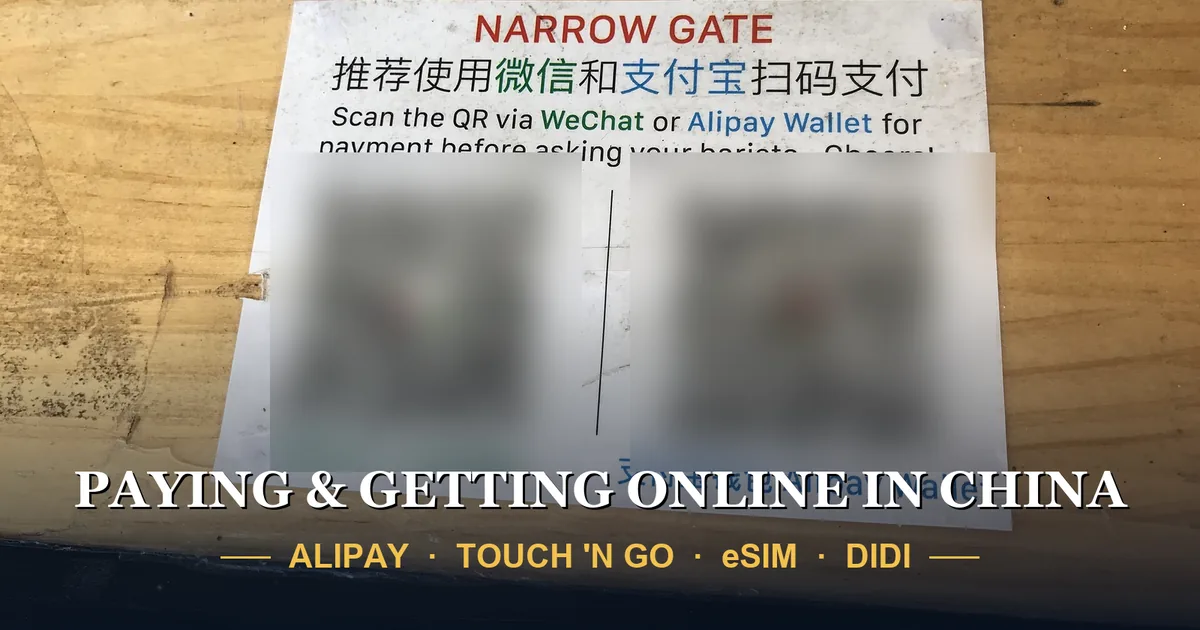
TL;DR — How Malaysians pay and get online in China: Alipay with a Malaysian card (fees explained), Touch 'n Go, cash, roaming vs eSIM, DiDi and train apps.
China runs on QR codes. Street stalls, taxis, temples and ticket gates all expect you to scan and pay with your phone, and Google, WhatsApp and Instagram do not work on Chinese networks. The good news: Malaysians can set all of this up from home in under an hour. Here is how to pay, get online and get around on a trip to China, with fees and limits explained.
Set up before you fly (checklist)
- Install Alipay (and optionally WeChat), link your Malaysian Visa or Mastercard, and verify with your passport.
- Turn on overseas transactions for that card in your banking app.
- Update Touch 'n Go eWallet as a backup payment method.
- Buy a roaming pass or travel eSIM (see below).
- Android users: download every app before you leave. Google Play does not work in China.
- Change RMB 500–1,000 cash at a money changer in Malaysia.
Paying: your 4 options
1. Alipay with your Malaysian card (main option)
Accepted almost everywhere, from hotels to night market stalls. You can scan the shop's QR code or show your payment code.
| Alipay foreign card rule | What it means |
|---|---|
| Payments of RMB 200 or less | No Alipay fee. |
| Payments above RMB 200 | A 3% fee on the whole amount (shown on screen before you confirm). |
| Overseas UnionPay cards | Exempt from that 3% fee. |
| Your bank | May add its own foreign transaction fee; check your card terms. |
Tip: for big bills such as hotels, paying by card at the counter (if accepted) or splitting payments can be cheaper. Limits and fees change from time to time, so check the card page in the app.
2. WeChat Pay
Also accepts foreign cards, with similar rules. Useful as a second option, especially where a small shop only shows a WeChat code.
3. Touch 'n Go eWallet
Through Alipay+, TNG eWallet pays at Alipay merchants in mainland China. In the app tap Pay, swipe up to show the Alipay+ code and choose Mainland China, or scan the merchant's Alipay QR. You pay in ringgit at the rate shown in the app. It does not work for person-to-person transfers or personal QR codes, so keep Alipay as your main method.
4. Cash and cards
Cash is still legal tender and useful in rural places like Snow Town, but many small vendors rarely handle it, so keep small notes. ATMs at airports and Bank of China branches accept Visa and Mastercard. Big hotels and malls increasingly take foreign cards; small shops usually do not.
Getting online
Google (Search, Maps, Gmail), WhatsApp, Instagram, Facebook and YouTube are blocked on Chinese networks, including hotel Wi-Fi. Your options:
| Option | What to know |
|---|---|
| Malaysian roaming pass | Your Malaysian telco's China roaming pass. Data is routed through your home network, so WhatsApp and Google usually work. Easiest option; compare day and week passes. |
| Travel eSIM | Cheaper for longer trips; most route data outside China, so blocked apps usually work. Check the eSIM says it supports these apps in China. |
| Chinese SIM card | Cheap data, but blocked apps stay blocked. Fine for Alipay, maps and DiDi. |
Hotel Wi-Fi follows Chinese rules, so switch to mobile data when you need WhatsApp.
Apps that make life easy
| App | What for |
|---|---|
| Alipay | Payments, plus mini-programs for DiDi taxis, metro QR codes and more. |
| DiDi | Ride-hailing. Use it inside Alipay, or the English DiDi app; foreign cards and international phone numbers generally work. |
| Amap (Gaode) or Baidu Maps | Google Maps is blocked and weak in China. iPhone users can also use Apple Maps, which works well there. |
| Trip.com | Hotels, flights and high-speed train tickets in English with your passport. The official 12306 rail app also has an English version. |
| A translation app | Install one that works in China (not Google Translate) and download offline languages. |
Trains and attractions use your passport
High-speed train tickets, many attractions (Harbin Ice and Snow World, Changbai Mountain) and hotel check-ins are real-name, so book with your passport details exactly as printed, and carry the passport every day.
Frequently Asked Questions (FAQ)
Can I use Touch 'n Go eWallet in China?
Yes, at Alipay merchants through Alipay+. It does not support person-to-person transfers or personal QR codes, so also set up Alipay with your card.
Is there a fee to use Alipay with a Malaysian card?
Payments of RMB 200 or less have no Alipay fee; above that, Alipay charges 3% of the whole amount. Your own bank may add a foreign transaction fee.
Does WhatsApp work in China?
Not on Chinese networks or hotel Wi-Fi. With a Malaysian roaming pass or a suitable travel eSIM, it usually works.
Do I still need cash in China?
A little. Most places take Alipay or WeChat Pay, but cash helps in rural areas and as a backup.
Can I book DiDi without a Chinese phone number?
Yes. Use DiDi inside Alipay or the DiDi app with your Malaysian number, and pay with your linked card.
More Northeast China winter guides
- Harbin, Snow Town & Changbai Mountain: 7-day itinerary
- How to choose a down jacket for Harbin (+ packing list)
- Harbin Ice and Snow World 2026–27 guide
A Northeast China winter guide by the ExFunCity Travel & Food Desk. Prices, fees and opening dates change; check official channels before you go. Cover photo: "QR codes for mobile pay in China" by Harald Groven via Wikimedia Commons, CC BY-SA 2.0; cropped, QR codes blurred and title added, and the cover is shared under the same licence.