News
MOF Crackdown: MyKad Access Blocked Over Massive BUDI95 Subsidy Abuse
By ExFunCity · 15 Apr 2026
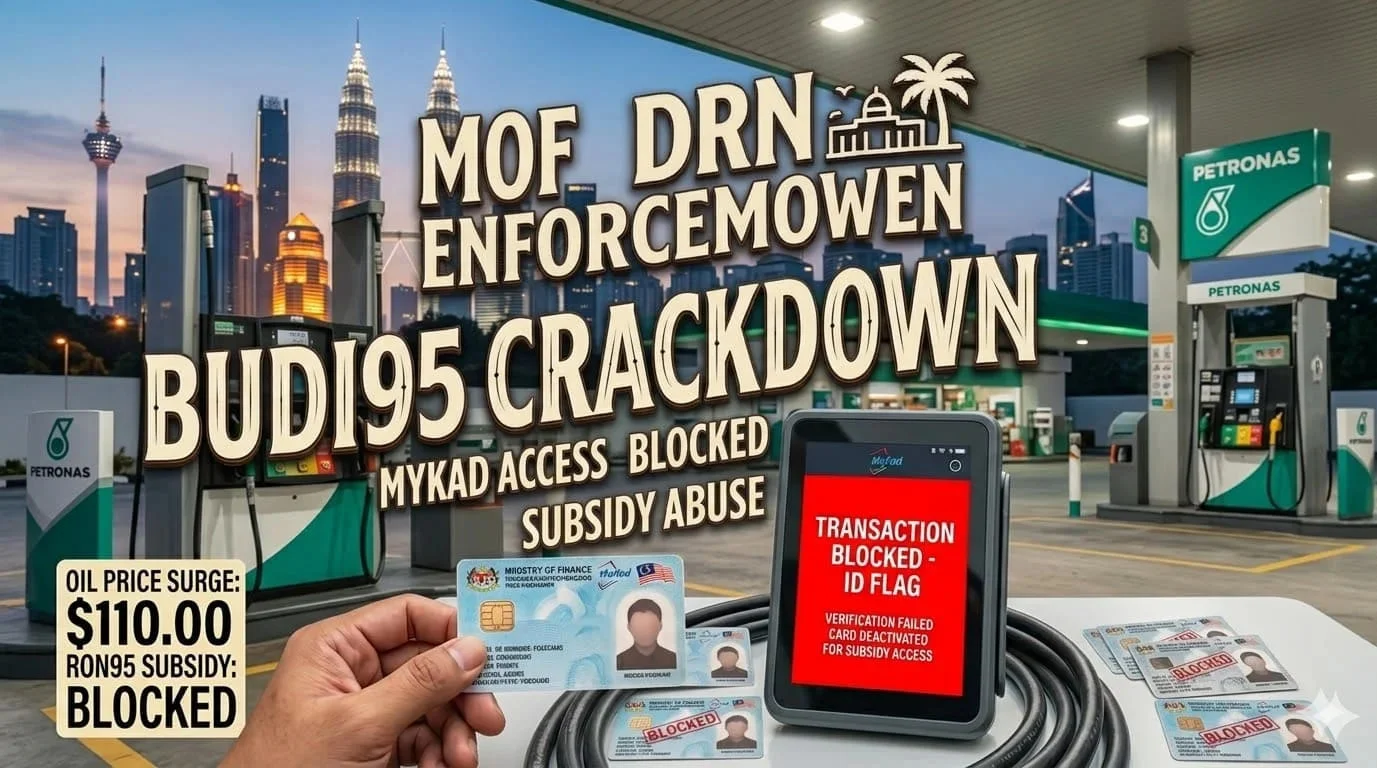
TL;DR — An in-depth investigative report on the Ministry of Finance crackdown against BUDI95 subsidy abuse, blocking MyKad access as global oil prices surge past $110.
MOF Crackdown: MyKad Access Blocked Over Massive BUDI95 Subsidy Abuse
The Escalating Crisis of BUDI95 Subsidy Abuse
As the implementation of Malaysia's long-anticipated fuel subsidy rationalization program enters its crucial maturation phase in the first quarter of 2026, an unforeseen and highly sophisticated economic crisis has emerged directly at the nation's petrol pumps. The Ministry of Finance has officially acknowledged a widespread, systemic issue regarding the severe misappropriation of government funds meant exclusively for the lower and middle-income demographics. This phenomenon, officially categorized by federal auditors as BUDI95 subsidy abuse, has prompted immediate, aggressive, and highly punitive intervention from federal authorities across multiple law enforcement agencies. The core of this complex issue revolves around the deliberate manipulation of the national identity card system, which serves as the primary digital verification gateway for motorists attempting to access subsidized fuel rates. With the geopolitical landscape becoming increasingly volatile and energy markets reacting aggressively to international conflicts, the financial integrity of the nation's domestic support mechanisms has never been more vulnerable or more critical to the overarching economic stability of the everyday Malaysian citizen.
The highly publicized introduction of the targeted RON95 subsidy was originally designed and modeled by economists to alleviate a crippling fiscal burden on the federal government. For decades, Malaysia operated on a blanket subsidy model that disproportionately benefited high-income earners, large commercial fleets, and foreign nationals, costing the treasury tens of billions of ringgit annually. Under the modernized BUDI95 framework, eligible Malaysians utilize their MyKad at point-of-sale terminals integrated directly into petrol pumps to receive a predetermined monthly quota of heavily subsidized fuel, authenticated in real-time against the Central Database Hub (PADU). However, exhaustive investigations over the past quarter have revealed the existence of highly organized syndicates and opportunistic individuals exploiting structural vulnerabilities within this digital handshake. The sheer scale of the financial leakage threatens to completely undermine the billions of ringgit projected to be saved through the initial rationalization process, forcing the government into a defensive posture to fiercely protect the national treasury.
Mechanics of the Exploitation: How the Verification System Was Compromised
Understanding the full anatomy of this financial exploitation requires a highly technical and operational look at how the verification system was deployed across thousands of independent petrol stations nationwide. The fundamental premise was theoretically sound: a direct database query linking a citizen's physical MyKad chip to their PADU profile, verifying their socioeconomic eligibility and available fuel quota in real-time before authorizing the discounted pump rate. Unfortunately, the nationwide execution met with harsh practical realities that criminal enterprises quickly mapped and systematically exploited. Investigative reports from the Royal Malaysia Police (PDRM) and the Ministry of Domestic Trade and Costs of Living (KPDN) indicate that the primary method of BUDI95 subsidy abuse involves the unlawful renting, digital cloning, and mass physical collection of valid MyKads belonging to eligible subsidy recipients who either do not own vehicles or do not utilize their full monthly fuel allocations.
Criminal syndicates operating predominantly near northern and southern border towns, as well as heavy industrial zones in the Klang Valley, have been found to aggressively harvest these unused quotas. By paying a marginal monthly fee—often as little as RM50—to low-income individuals, these groups acquire physical possession of hundreds of valid identity cards. They then systematically deploy coordinated teams of "runners" to cycle through multiple petrol stations, filling up heavily modified tanks concealed within commercial vans or seemingly standard lorries under the guise of ordinary passenger vehicles. This heavily subsidized fuel is then rapidly siphoned at secure locations and resold on the black market to domestic industrial players who are ineligible for subsidies, or smuggled across international borders at a massive profit margin. Furthermore, isolated but deeply concerning incidents of hardware tampering at the pump level have been recorded, where syndicate technicians manipulate card readers to bypass the biometric and physical verification protocols intended to ensure the actual cardholder is present during the transaction.
The Role of Point-of-Sale Vulnerabilities and Latency Exploitation
Compounding the physical trading of identity cards are complex software loopholes discovered during high-traffic periods at the pumps. During peak commuting hours, the network latency between the localized pump terminal and the centralized PADU server occasionally defaults to an "offline approval" mode to prevent massive, disruptive queues at petrol stations. Fraudsters have meticulously mapped these latency periods and offline fallbacks, executing multiple rapid transactions across different geographic locations before the central ledger can synchronize and reconcile the duplicated quota deductions. This sophisticated circumvention highlights the urgent need for a more robust, low-latency telecommunications infrastructure capable of securely handling the millions of concurrent micro-transactions processed daily without defaulting to unverified approvals.
The Swift and Unforgiving Ministry of Finance Crackdown
In direct response to the alarming internal audit reports detailing the immense extent of the financial leakage, the federal government has initiated an unprecedented and sweeping enforcement campaign. The Ministry of Finance crackdown is characterized by an absolute zero-tolerance policy toward any identified anomalies in fuel purchasing patterns. Utilizing advanced data analytics, artificial intelligence, and machine learning algorithms applied directly to the PADU transaction logs, authorities are now actively hunting for statistical outliers in real-time. A vehicle registered to a single owner in a rural district purchasing maximum quotas of RON95 daily across multiple stations in the Klang Valley, for example, immediately triggers an automated red flag within the enforcement division's central monitoring dashboards, prompting immediate localized intervention.
The most tangible, immediate, and controversial consequence for those flagged by the algorithmic system has been the abrupt suspension of their digital purchasing privileges. Across the nation, thousands of individuals and suspected syndicate runners have arrived at petrol stations only to find their MyKad access blocked permanently at the pump terminals. A stark red error code flashes on the screen, indicating that the card has been blacklisted under the Anti-Money Laundering, Anti-Terrorism Financing and Proceeds of Unlawful Activities Act (AMLA), pending a full and exhaustive financial investigation. This aggressive tactic serves a highly effective dual purpose: it instantly halts the financial bleeding from the treasury and serves as a highly visible, public deterrent. It signals unequivocally to the general public that the state possesses both the technological capability and the political will to monitor, track, and severely penalize fraudulent activity at the absolute micro level.
Navigating the Global Oil Prices Surge: Macroeconomic Realities
The absolute urgency of halting this sophisticated financial leakage cannot be overstated, particularly when viewed through the unforgiving lens of current macroeconomic indicators. The recent and severe geopolitical destabilization in the Middle East, specifically the escalating conflicts and blockades affecting the Strait of Hormuz, has completely upended global energy forecasts for 2026. With major international transit routes threatened and key production facilities facing potential collateral damage, the global oil prices surge has pushed Brent crude aggressively past the psychological and financial threshold of $110 per barrel. For an importing nation that relies heavily on a managed float system to shield its populace from crippling inflationary shocks, every single drop of subsidized fuel that falls into the hands of smugglers or ineligible industrial users represents a direct, critical, and utterly unsustainable drain on the federal reserves.
When global oil prices hovered comfortably around the $70 to $80 mark, the fiscal deficit impact of minor subsidy leakages, while fundamentally undesirable, was mathematically manageable within the broader federal budgetary framework. However, at a sustained $110 per barrel, the financial delta between the subsidized domestic pump price (maintained at RM2.05 per liter for eligible citizens) and the actual, un-subsidized global market cost (nearing RM4.80 per liter) is astronomical. Leading economists and central bank analysts warn that if the current accelerated rate of BUDI95 subsidy abuse is not decisively curtailed within the next fiscal quarter, the government may be forced to make deeply unpopular decisions. These could include drastically reducing the monthly fuel quota for legitimate users, abandoning the subsidy entirely, or dangerously widening the fiscal deficit, which would inevitably trigger a sovereign downgrade by major international credit rating agencies. Protecting the operational integrity of the targeted RON95 subsidy is no longer merely a matter of domestic policy enforcement; it has rapidly evolved into a critical, non-negotiable pillar of Malaysia's macroeconomic defense strategy in an increasingly volatile global environment.
The Appeals Process and the Future of Fuel Distribution in Malaysia
While the swift enforcement actions and digital blockades have been largely praised by fiscal conservatives, economists, and anti-corruption watchdogs, the sweeping, automated nature of the algorithmic flagging has inevitably resulted in significant collateral damage. Legitimate, law-abiding users who share vehicles within large, multi-generational B40 households, or those who commute extraordinary distances across state lines for daily employment, have occasionally found themselves caught in the digital dragnet. Recognizing the severe disruption to daily life and livelihoods caused when a citizen's MyKad access blocked erroneously, the Ministry of Finance has rapidly established a specialized, fast-track appeals tribunal. This dedicated task force is designed to manually review flagged accounts, cross-reference employment data, and clear false positives within a strict 72-hour window, ensuring that genuine citizens are not unjustly penalized by the system's aggressive security protocols.
Looking ahead to the remainder of the decade, the current crisis is serving as a powerful catalyst, forcing a rapid acceleration of secondary verification technologies within the government sector. Policymakers and technology vendors are already in the advanced stages of drafting proposals for BUDI95 2.0, an upgraded framework which seeks to phase out the reliance on the physical MyKad entirely in favor of a highly secure, integrated digital ecosystem. Future iterations are heavily expected to mandate biometric multi-factor authentication seamlessly via the national digital identity smartphone application (MyDigital ID), linking the fuel transaction not just to the verified citizen, but directly to the registered vehicle's internal telematics system and RFID tags. Until such advanced, tamper-proof technologies can be deployed nationwide, the high-stakes cat-and-mouse game between government data auditors and organized subsidy syndicates will remain a defining, critical feature of Malaysia's painful but necessary transition toward targeted economic assistance.