News
FBM KLCI Rebounds Past 1,710 as Trade Growth Shrugs Off Global Jitters
By ExFunCity · 21 Apr 2026
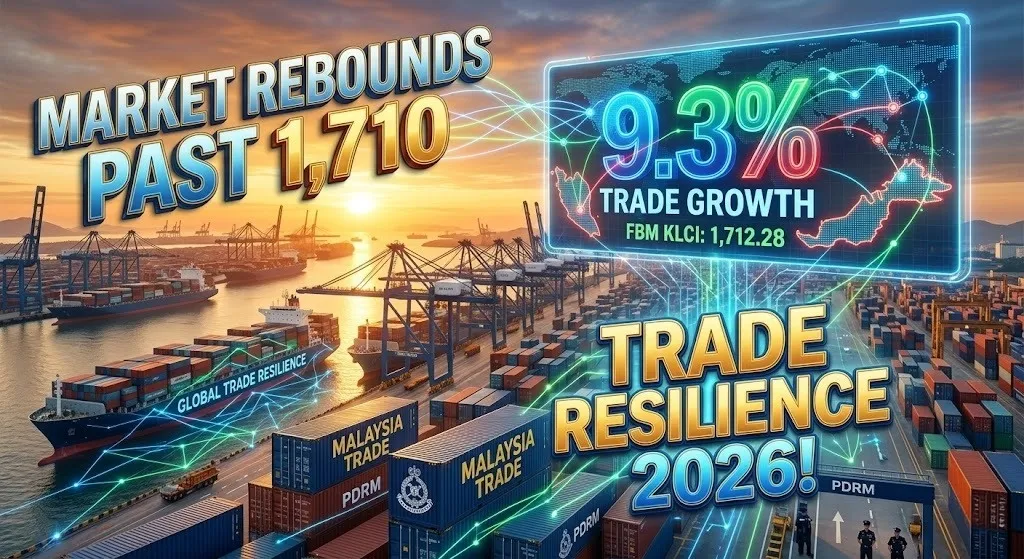
TL;DR — Bursa Malaysia's benchmark index rose to 1,712.28 today. Strong March trade growth of 9.3% and news of an RM5 billion MSME aid package investor sentiment.
FBM KLCI Rebounds Past 1,710 as Trade Growth Shrugs Off Global Jitters
Bursa Malaysia staged a strong recovery today, April 21, 2026, with the benchmark FBM KLCI rebounding past the 1,710 level. The market's upward momentum was fueled by better-than-expected trade data for March, which showed that Malaysia's economy remains resilient despite the "geopolitical storms" in West Asia. Investors were further heartened by the government's rapid implementation of the RM5 billion MSME rescue package, signaling a proactive approach to protecting the domestic economy from global energy shocks.

March Trade Growth Hits 9.3% Amid Global Uncertainty
In a press conference held earlier today, Matrade Chairman Datuk Seri Reezal Merican Naina Merican revealed that Malaysia's total trade grew by 9.3% year-on-year, reaching a staggering RM272.95 billion in March. This growth was largely driven by a surge in demand for Electrical and Electronic (E&E) products and specialized machinery, proving that Malaysia’s role in the global tech supply chain remains indispensable.
Key highlights from the trade report:
- E&E Resilience: Semiconductors and electronic integrated circuits led export growth.
- Diversified Markets: Increased trade with ASEAN and emerging partners offset slower growth in Western markets.
- Trade Surplus: Malaysia maintained its 71st consecutive month of trade surplus, providing a strong cushion for the Ringgit.
Market Sentiment Lifted by SJPP Aid and Renewable Energy Targets
The FBM KLCI rose 9.98 points to close the morning session at 1,712.28. Beyond the trade data, the market reacted positively to Deputy Prime Minister Datuk Seri Fadillah Yusof’s announcement regarding the nation’s energy transition. Fadillah confirmed that Malaysia is on track to hit a 32% renewable energy (RE) capacity this year, with a new tender for the LSS 6 (Large-Scale Solar 6) project expected to open soon.
Momentum for Utility and Tech Stocks
Utility players, particularly Tenaga Nasional Berhad (TNB), saw increased buying interest as the nation accelerates its grid upgrades to support the data center boom. Similarly, technology stocks on the Main Market benefited from the upbeat sentiment surrounding the Solar KTM success and the broader push for a "Sovereign AI" infrastructure.
Bridging the Gap: The RM5 Billion MSME Safety Net
Prime Minister Anwar Ibrahim's announcement of the expanded SJPP guarantee facility has started to filter through to the real economy. By increasing financing coverage to 80% for sectors like logistics and tourism, the government is effectively "buying time" for local businesses to adapt to high fuel costs. This move has reduced fears of a wave of MSME defaults, which had previously been a major drag on banking stocks.
Managing the "Refinery Gate" Reality
While the market is optimistic, Petronas and other industry leaders continue to monitor the "refinery gate" costs. With crude prices hovering around $112–$115 once shipping and insurance premiums are factored in, the government's targeted fuel subsidy framework remains the most critical tool for preventing runaway inflation.

Outlook: A Cautious But Confident Trajectory
Analysts from Malacca Securities noted that while the market is awaiting more clarity on the West Asia blockade, the current "decoupling" of Malaysian trade from regional turmoil is a significant positive. If trade growth remains near double digits and the transition to renewable energy continues to lower long-term operational costs, Bursa Malaysia could see the 1,750 level by mid-year.
Conclusion: Resilience in Motion
The events of April 21, 2026, showcase a Malaysia that is not merely surviving a crisis but actively evolving through it. From the record-breaking trade figures to the "Smart Fuel Guard" and "Solar Rail" initiatives, the nation is proving that technological sovereignty and economic resilience are the best defenses against a volatile world.